


WHAT IS IT
Get to know the land before building.
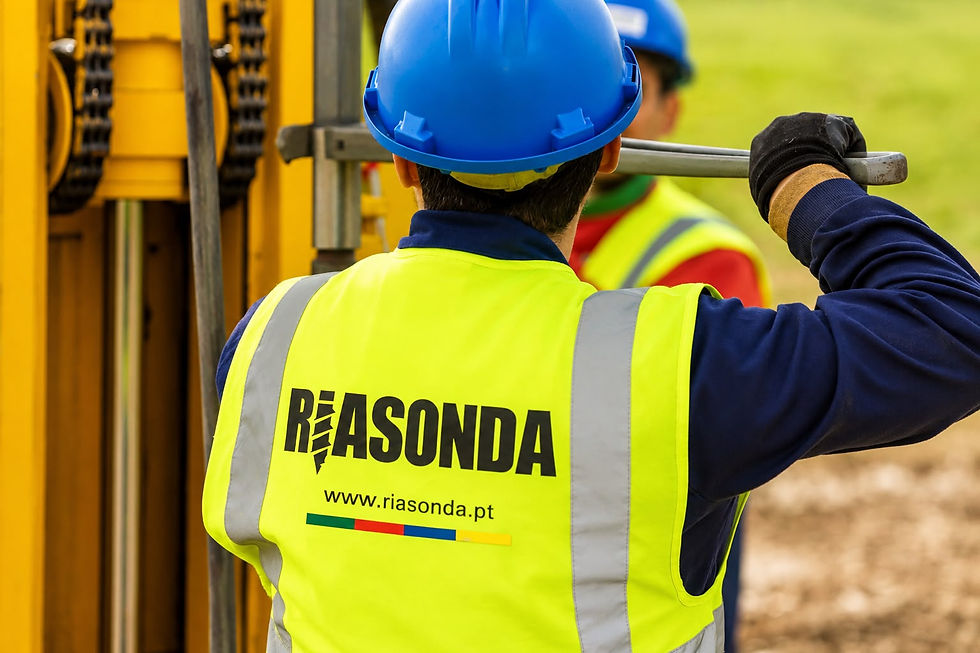
Geotechnical prospecting aims to collect information on-site for subsequent interpretation and development of a geotechnical foundation model.
This procedure allows for the establishment of the resistance and deformability parameters of the soil mass and is indispensable as a support for any foundation or geotechnical works project. Riasonda has its own fleet of drilling equipment and uses the appropriate methodologies for each type of work.
What we accomplished
Methodologies adapted to each project and type of terrain.
Sondagens e Furação
Rotary drilling with sampling, hollow auger and down-the-hole hammer. Methodology selected based on the terrain and the objective of the study.
In Situ Tests
DPSH, DPM, DPL, CPT, CPTu and SPT. Geotechnical characterization of soils during drilling or independently.
Geophysical Prospecting
Seismic refraction, electrical resistivity, and ground-penetrating radar. For projects requiring in-depth characterization without drilling.
Laboratory Tests
Particle size analysis, consistency limits, moisture content, uniaxial compression, direct shear and Proctor tests, among others. In partnership with certified laboratories.
Hydrogeological Prospecting
Lefranc, Lugeon, and Slug Tests. For projects involving the characterization of groundwater levels and soil permeability.
Exploration Wells
Drilling wells for direct visual inspection of the terrain and collection of samples at depth.


Applications
Used in construction, infrastructure, and energy projects.
Foundation design projects for buildings and infrastructure.
Geological and geotechnical studies for licensing.
Prospecting for photovoltaic solar power plants
Assessment of soil and water contamination.
Characterization of soil masses for perimeter containment and slopes.
Environmental prospecting and radioactivity assessment
